Launch of the TRAMAS platform – technologies, weaves, territories
#Latin America #social environmental justiceHave you ever stopped to think about the socio-environmental impacts of digital technologies? About who profits and who resists the territorial conflicts at the far ends of these production chains? What is Latin America’s role in this global dynamic? And what actions can we take from within our own territories?
Tramas – technologies, weaves, territories offers you some clues.
Tramas is an action-research project by the Coalición Feminista Decolonial por la Justicia Digital y Ambiental (Decolonial Feminist Coalition for Digital and Environmental Justice), which helps to untangle the complex entanglements between the expansion of digital infrastructure, the development of AI, and socio-environmental conflicts, making visible the threads that weave together webs of injustice and territorial resistance across Latin America.
About the Coalición Feminista Decolonial por la Justicia Ambiental y Digital
The Coalición is an intention, a political bond, loving and built on trust, between longtime friends who, through their work in technology, human rights, and feminisms, converged around a shared unease over questions still unanswered in the field of digital rights.
“What is happening with this paradigm of connectivity? How does it move in terms of political economy, for example, of the impacts on territories? What link does this have with the climate collapse we are living through, with the inequality that deepened during the pandemic?” Loreto (Maka) Bravo at the 4th Conversatorio on Decolonial Journalism.
To answer these questions, it was necessary to go into the field, to listen to the defenders of territories who are paying the physical costs, in their bodies, in their health, in their relationships, so that this connectivity can exist. In this way, we documented the different dimensions of the hidden impacts of Big Tech’s political economy, and the tangle of resistances from various parts of Latin America, in order to make visible the struggles that communities and defenders are waging in Mexico, Brazil, Chile, and elsewhere in Central America, documenting it all in case studies from a feminist and decolonial perspective.
Our Coalición is made up of various organizations and activists based in Chile, Brazil, and Mexico. Currently, the coalition includes: Coding Rights (Joana Varon and Mariana Tamari), Instituto Latinoamericano de Terraformación (Paz Peña), Sursiendo (Jes Ciacci), Paola Ricaurte (Rede Tierra Común and the Feminist AI Research Network) and Loreto Bravo.
We document the challenges, and also the RESISTANCES!
About the Cases
We listened to territory defenders in Querétaro, Jalisco (Mexico), Penco (Chile), and Matopiba (Brazil) to talk about data centers, rare earths, toxic waste from the technology industries, and the imagined futures of agribusiness and the technologies of expulsion that fuel the expansion of monoculture, threatening forests, family farming, and other modes of agricultural production.
Our dear Loreto (Maka) Bravo guided the entire process of research and conception of the tramas, so that we could make visible how all these struggles are interwoven! The same colonial logic that extracts minerals in Chile, poisons rivers in Mexico, and appropriates land in Brazil is the one that feeds multi-million-dollar corporations!
From feminist and decolonial perspectives, we aim to connect social movements and territory defenders with activists for more just technologies.
Tech, Big Agro, Big Money: technologies of expulsion and the impacts of the digitalization of Brazilian monoculture
Mariana Tamari, Joana Varon
Territories: The Matopiba Cerrado and Agrishow in Ribeirão Preto, Brazil
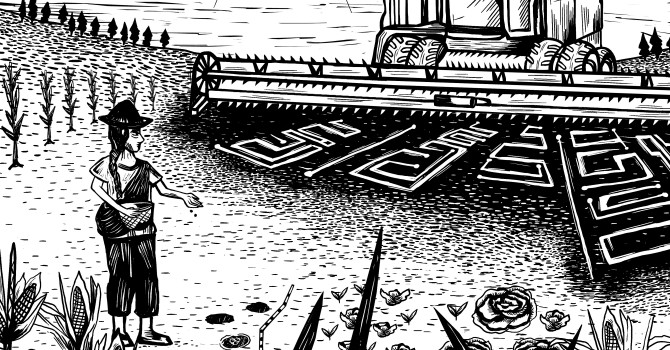
What imagined futures and technologies do the large agribusiness corporations promote? How does this vision accelerate monoculture, threatening crop diversity and our food security? This study moves between two territories: Agrishow in Ribeirão Preto, where we map the technological imaginaries of Big Agro; and the case of Gleba Tauá (TO), in the Matopiba Cerrado, “the new agricultural frontier,” where digitalization brings new challenges to century-old agrarian conflicts. We analyze how drones, AI, and big data have masked deforestation, land concentration, and violence against communities, promoting digital land-grabbing and the expulsion of communities, setting ancestral knowledge and socio-environmental justice against the exclusionary narrative of “high-tech Agro.”
Joana Varon carried out the field research at Agrishow, the agribusiness technology fair held annually in Ribeirão Preto/SP, gaining an immersive experience of the immense technological and narrative capacity of one of the leading sectors of the Brazilian economy. Together with Mariana Tamari, they interviewed Karina Kato, Larissa Packer, and Vinicius Gomes de Aguiar, with research collaboration from Antonia Laudeci Oliveira Moraes, to analyze the impacts of this digitalization, designed for monoculture, on other forms of cultivation, such as family farming.
Geopolitics of the end of the world: rare earths in Penco, Chile
Paz Peña, Cecilia Ananías
Territories: Penco, Chile
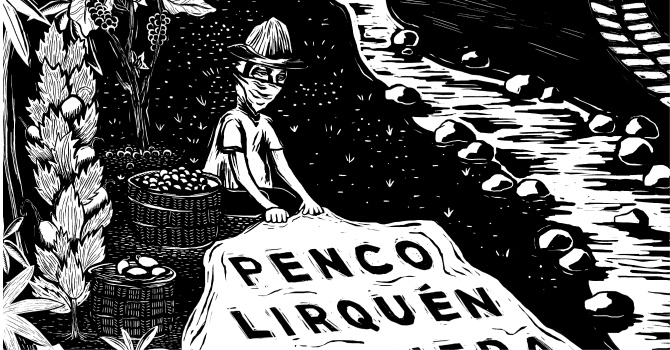
For years, the residents of Penco, a small town in southern Chile, have resisted the installation of a mining project to extract rare earths in their territory. The most recent push to approve the project is the West’s trade war against China, which is desperately seeking new rare earth deposits both to challenge the Asian country’s dominance in mineral production and to obtain raw materials for the technology, automotive, and military industries. The community resistance in Penco and the political and economic pressures to approve the project reveal the contradictory colonial logics of 21st-century capitalism, which bets on a supposed sustainability through digitalization and green energy.
“It’s not drought, it’s plunder” Querétaro, the valley of data centers
Paola Ricaurte Quijano, Teresa Roldán Soria
Territories: Querétaro, Mexico
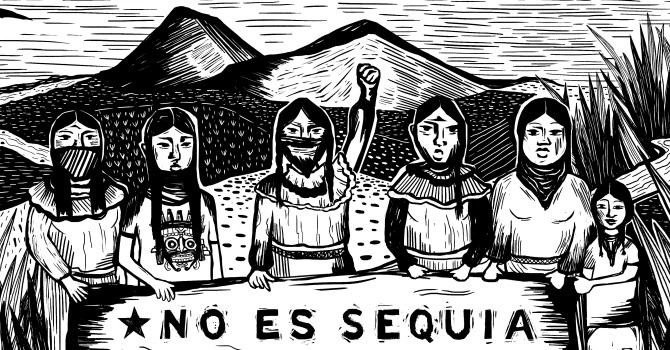
Querétaro, a small state in central Mexico, has consolidated itself as the country’s leading hub for the data center industry. The rise of this sector corresponds to the consolidation of neoliberal policies that favored its expansion: the privatization of state-owned enterprises, financial deregulation, and free trade agreements that cemented the country’s subordinate insertion into the digital economy. The impacts on people and territory are profound, yet they are usually downplayed in the government’s industrializing narrative, marked by institutional opacity. Environmental groups, human rights defenders, communities, and in particular Indigenous peoples and collectives defending water and territory now face a threat of dispossession of the commons linked to emerging technologies.
Mexican Silicon Valley: socio-environmental impacts of digital colonialism and acts of resistance for a dignified life
Jes Ciacci, Sofía Enciso
Territories: El Salto, Jalisco, Mexico
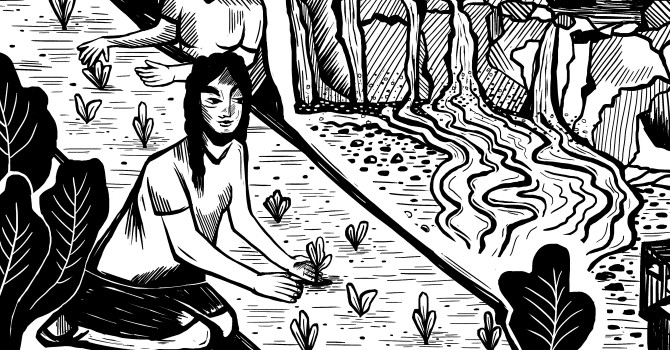
El Salto, a municipality in Jalisco within the Guadalajara metropolitan area, owes its name to an 18-meter waterfall on the Santiago River. Since the 19th century, the region has undergone a devastating process of industrialization: first a hydroelectric plant, then textile factories, and today 675 companies position it as the “Mexican Silicon Valley.” After decades of exploitation that caused serious environmental damage and human rights violations, the Plan México 2025 threatens to intensify this historic crisis through increased foreign investment. The collective Un Salto de Vida, born 20 years ago, resists by weaving together strategies of territorial defense, political struggle, and environmental restoration, building politicized hopes that challenge a century-old extractive model.
TRAMAS invites you to a new way of looking at the digital economy.
Visit us at https://tramas.digital
Available in Portuguese, Spanish and English.
Watch the platform launch at the Digital Culture Center in Mexico City.
For the platform, illustrations are by Giovanna Joo, web design by Cooperativa de Diseño, web development by Diana K. Cury, coordination and visual conception by Joana Varon.
Spanish and Portuguese translation and revision by Ana Cristina Carvalhaes. The Spanish/Portuguese-English translation was done by Luisa Barraza Caballero, and was revised by Alicia Z. Daniel.
The project was funded by the Green Screen Coalition’s Green Screen Catalyst Fund, with additional support from the Heinrich Böll Foundation Brazil for the Brazilian case.