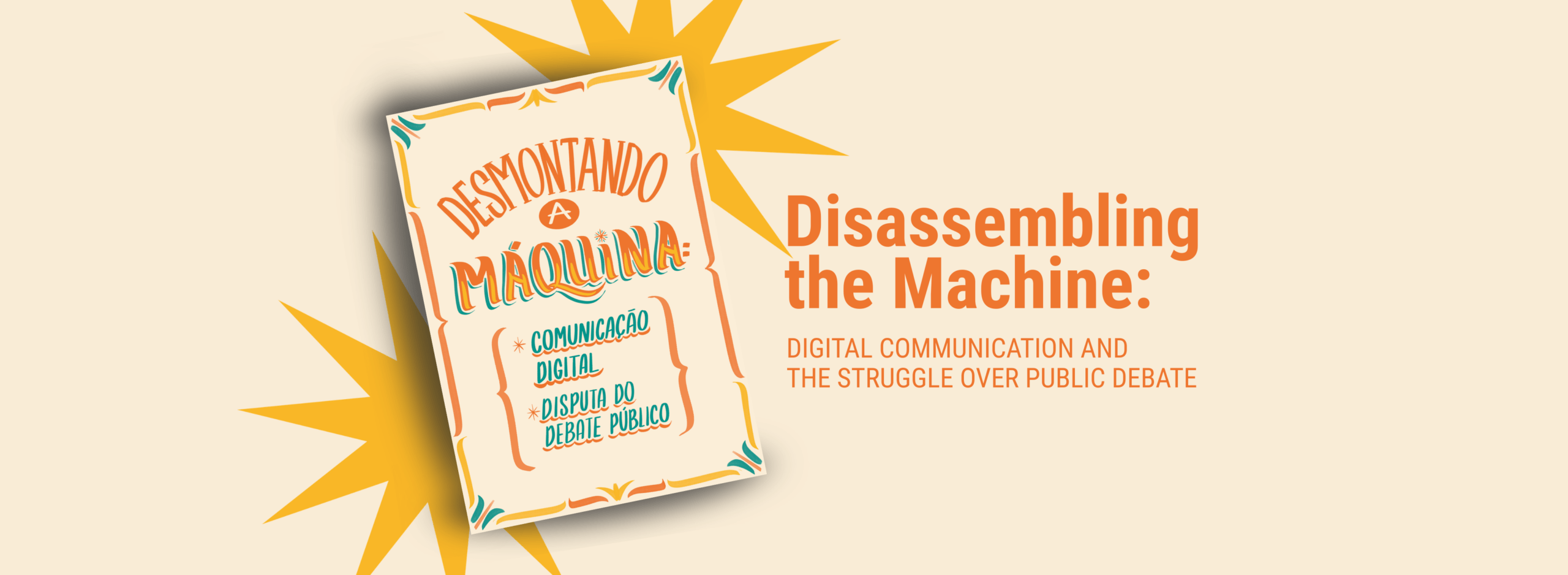
Disassembling the Machine: the guide for those contesting the public debate in 2026
#artificial intelligence #elections #misinformation #political violenceBrazil is about to hold the first elections in which generative AI tools are widely available, at a moment when gender-based political violence and disinformation are both on the rise. What tactics do we need to develop to keep contesting public debate online? It is in this context that Coding Rights is releasing Desmontando a máquina: comunicação digital e disputa do debate público (in English: “Dismantling the Machine: digital communication and the struggle over public debate”), a guide produced in partnership with Mulheres Negras Decidem, Instituto Democracia em Xeque, NetLab UFRJ and Sleeping Giants Brasil.
The machine
A piece of disinformation about your work or your collective starts circulating on a Thursday night. It doesn’t run in a newspaper, it doesn’t come out of a livestream: it is born in a Telegram group of 150 people, tested there, adjusted, and by Saturday it is already in fifty neighborhood WhatsApp groups, with audio, with screenshots, with an outrage that looks legitimate. By Monday, when your team finally sees it, the story has changed three times and has acquired a face: yours, pasted into a video you never recorded. You sit down to respond and discover the worst part: any answer you write will repeat the accusation.
This is not bad luck, nor the price of being online. It is the normal functioning of a system that was designed, decision by decision, so that content activating emotions like fear and anger travels faster and further than content that informs. The machine is doing exactly what it was built to do.
In six modules, Desmontando a máquina reverse-engineers the platforms, shows what artificial intelligence changes in the 2026 election and delivers practical protocols for elected officials’ offices, campaigns, social movements, organizations and communicators. It was developed from a wager: this moment is not only one of risk, but also one of opportunity. The opportunity to approach communication strategically and to take up technologies as tools of struggle and of collective power building. The game is still open, and this guide is a tool for playing it better. Available as a free download.
What’s inside
The material is organized in six modules, meant to be read in order or consulted in an emergency.
1. How do people in Brazil get their information? Before talking about disinformation, it is worth knowing how information arrives. The survey Desigualdades Informativas (in English: “Informational Inequalities”), by Aláfia Lab, shows that social media is already the country’s main source of information, at 53.5%, ahead of television and news portals, while messaging apps keep growing: 21.5% in 2024, 28% the following year. But the average hides what matters most. Where each person gets their information varies a great deal by gender, race, education and income, which means the informational board is already uneven before disinformation even enters the game.
2. The Machine: how platforms were designed to favor radicalizing content. Algorithms reward intense emotion over accuracy, and monetization does the rest of the job, turning outrage into a business model. The module also retraces the path a lie usually travels, tested first in the dark of a Telegram group, amplified in WhatsApp groups and only then released into the daylight of open platforms, and it explains dark pooling, the scheme in which the front door is locked but the ads keep coming in through the back. It ends with a figure that explains a great deal: among the regions assessed, Brazil records the lowest levels of access to platform data. And it is hard to prove what you cannot measure.
3. The psychology of radical persuasion. The module breaks down the eight triggers that disinformation pulls, from fear and anger to belonging, urgency, threatened identity, conspiracy, false authority and false impartiality. Then it turns the lens on our own side and names the traps we fall into when we respond, such as leading with the denial instead of the truth, repeating the accusation, adopting the attacker’s vocabulary, and reacting with text alone. But it does not leave the critique standing on its own: in place of each mistake, it offers a counter-narrative script you can follow the moment an attack happens.
4. Gender-based political violence as a silencing tactic. The study Regime de Ameaça (in English: “Regime of Threat”), by Instituto Marielle Franco, Justiça Global and Terra de Direitos, documented 77 cases between 2021 and 2025, and in 71% of them the threat involved death or rape. Meanwhile, in four years of Brazil’s Law on Political Violence Against Women, the Monitor run by Instituto Alziras has not recorded a single final conviction. The guide calls this what it is: not a side effect of public debate, but a deliberate tactic to empty that debate of certain bodies. And it does not stop at the diagnosis, because it shows how to document evidence, lock down your accounts and reach support channels at the moment the net tightens.
5. AI and elections: the new contested terrain. The module explains what Brazil’s Superior Electoral Court requires and prohibits under Resolution 23.755/2026, and where the gaps are. It then runs through the deepfakes already in circulation, from face-swaps to deepnudes, including voice cloning, which human ears fail to catch 27% of the time, according to a University College London study. A table sets out where detection tools help and where they fail: they work well with public figures who have a large online presence, and poorly with precisely those who have little. For anyone who becomes a target, there is a response protocol.
But the module is not only about defense. It starts from a blunt premise: ignoring AI is not neutrality, it is a disadvantage. And it points to legitimate uses for our field, from producing properly labeled content to monitoring adversarial narratives and making materials accessible.
6. Effective progressive communication. The last module moves from reaction to initiative. Instead of responding to whatever the other side puts on the agenda, it proposes monitoring earlier to get there first, and instead of depending on the reach platforms hand out, building our own network of people who create and distribute content. It also suggests occupying the channels where we have less presence, such as YouTube and WhatsApp, contesting space outside the bubble, and accepting that choosing an AI tool is a political decision like any other. None of this is about speaking louder. It is about communication more rooted in communities, more consistent over time and more honest about the emotions at play.
“And understanding that architecture is a condition for contesting it.”
Desmontando a máquina, Module 2
Protocols to use on Monday morning
Perhaps the best news about this guide is that it does not stop at the diagnosis. Every module delivers step-by-step instructions you can apply, from the ten-step verification protocol, which tells you whether what landed in your group is true, to the deepfake response script. And the counter-narrative one opens with an instruction that goes against every instinct of anyone who works in communication: stop for twenty minutes before writing anything, because haste is on the attacker’s side. At the end come the contacts we forget precisely when we most need them, such as SIADE, the electoral court’s disinformation alert system, the fact-checking agencies, Semanal DX, Maria d’Ajuda, Plantão Colmeia, SaferNet Brasil and CVV, Brazil’s emotional support and suicide prevention line.
Download it, read it, pass it on
The material is free and was made for elected officials’ offices, campaigns, civil society organizations, social movements, communicators and journalists working in defense of human rights, social justice and environmental justice.
The guide is published in Portuguese.
About the guide
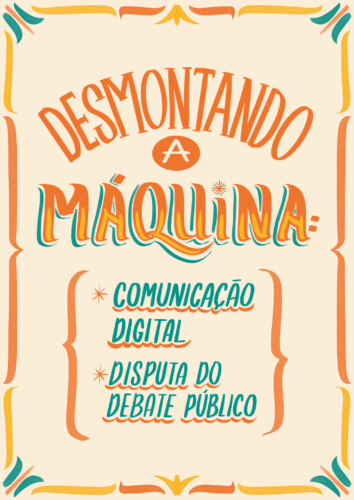
Desmontando a máquina: comunicação digital e disputa do debate público was produced by Coding Rights in partnership with Mulheres Negras Decidem, Instituto Democracia em Xeque, NetLab UFRJ and Sleeping Giants Brasil. Thank you for joining forces with us.
Published in May 2026, under a Creative Commons CC BY-NC-SA 4.0 license.