Idec and Coding Rights call on Brazilian authorities to investigate Ray-Ban Meta smart glasses
#consent #privacy #surveillanceOrganizations point to covert recordings, cases of gender-based violence and unlawful processing of personal data, and request a coordinated investigation into the sale of the devices
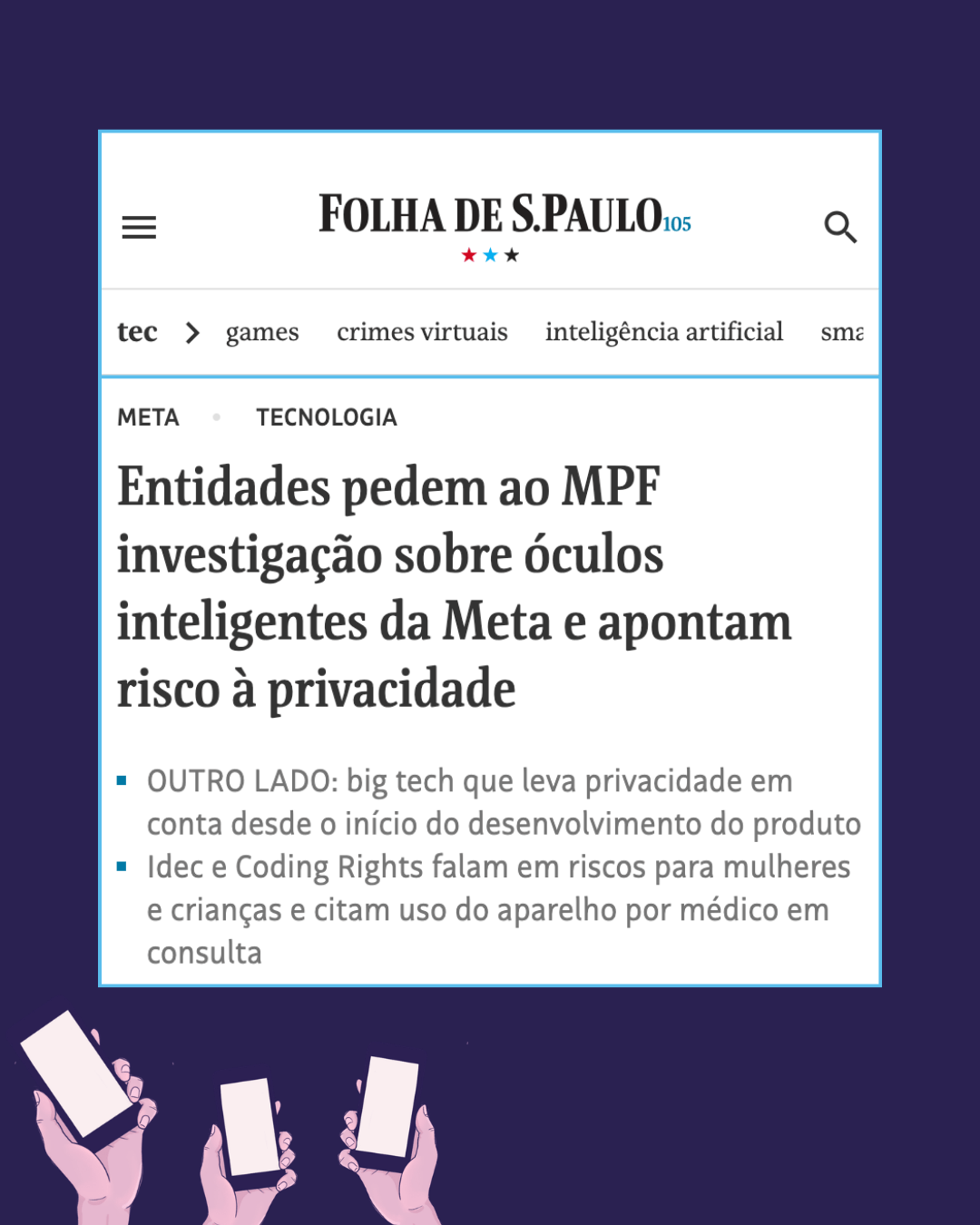
São Paulo, August 20, 2026 – The Institute for Consumer Defense (Idec) and Coding Rights have filed a formal complaint with the National Data Protection Authority (ANPD), the National Consumer Secretariat (Senacon) and the Federal Public Prosecutor’s Office (MPF), calling for coordinated action by the three authorities to investigate risks and violations of the General Data Protection Law (LGPD) and the Consumer Protection Code (CDC), as well as possible violations of the rights of women, children and adolescents, arising from the sale of Ray-Ban Meta smart glasses in Brazil.
The device makes it possible to record video, take photos and capture audio of the people around the wearer, often without their noticing, in a scenario of constant, covert surveillance that has already given rise to complaints of privacy and data protection violations, and that particularly affects women, girls, children and adolescents.
What changes compared to a phone
Launched in Brazil in September 2025, the product combines Ray-Ban design with Meta features that allow the wearer to discreetly record everything they see. The complaint argues that the central difference lies not in the capacity to capture images, but in the possibility of resisting it. Raising a phone to film is a socially legible gesture: it opens a window, however brief, for the person being filmed to step out of frame, cover their face, verbally refuse or identify who is recording them. The glasses eliminate that window — recording is triggered by a discreet tap on the temple and, in the most recent generations, by micro-gestures captured by an electromyography wristband. The product also integrates directly with Instagram and Facebook for real-time sharing.
The glasses have an LED light a few millimeters wide that blinks when the camera is activated, and it is only visible to someone looking directly at the frames, in good lighting conditions. In addition, there are technical indications that this mechanism can be circumvented by temporarily blocking the sensor or modifying the hardware — with tutorials available on the internet itself — rendering invisible any warning that the device is recording. For Idec and Coding Rights, a safeguard that depends on the good faith of whoever intends to circumvent it does not protect the consumer: it merely transfers the burden of surveillance onto them.
The expansion of smart glasses helps put the urgency of the regulatory debate into perspective. According to the consultancy IDC, the global market sold 9.6 million units in 2025 and is expected to reach 13.4 million by the end of 2026. Meta leads this segment, accounting for roughly 76% of global sales.
Concrete cases and disproportionate impact on women
The risks are no longer a theoretical concern. The document compiles incidents already recorded in Brazil and abroad. Women have been the target of unauthorized recordings in public spaces and, more recently, the technology has reached settings in which privacy should be inviolable. In Salvador (Bahia), a gynecologist was reported for using smart glasses while examining a patient. For the organizations, the case exposes how devices capable of recording images and sound in a virtually imperceptible way can amplify situations of violence, harassment and rights violations.
The organizations point to three cumulative reasons for the disproportionate impact on women and girls: the device disarms a pre-existing repertoire of self-protection specific to women as they move through the city; the documented cases follow a dominant pattern of men filming women; and the harm does not end with the capture itself — it includes the loss of control over one’s own image for an indefinite period, the risk of AI manipulation (including sexual deepfakes) and the diffuse effect of anticipatory surveillance.
“From the consumer’s standpoint, what we have here is a company that placed a dangerous product on the market and transferred the task of protecting oneself from it to people who never even bought the device. We are not talking about a minor technical detail, but about fundamental rights such as dignity, privacy and intimacy. This is the opposite of what the law requires of any supplier, and it now falls to the authorities to demand that this product operate only in accordance with the law, with greater transparency throughout the process, so that the public has clarity about the risks to which it is exposed,” says Julia Abad, of Idec.
“Imperceptible filming does not create a new risk on neutral ground. It is one more tool enabling the growth of gender-based violence. It is no coincidence that the pattern in the cases documented so far is men filming women for humiliation, non-consensual eroticization or monetization. Now imagine having to walk down the street suspicious of every pair of glasses — on the bus, in the doctor’s office. It shouldn’t be on us to protect ourselves from a product; the product should have left the factory without posing a threat,” analyzes Joana Varon, director of Coding Rights.
For Idec and Coding Rights, effective protection must also operate at the level of the product and the data flow — precisely within the remit of the three authorities notified.
Data sent to the cloud and reviewed by third parties
The complaint stresses that data processing does not end at the device: content is transmitted to Meta’s servers and may be reviewed and labeled by service providers to train artificial intelligence models. International investigations have reported that outsourced workers viewed people in intimate moments, in bathrooms and changing clothes, as well as recordings containing banking data and private conversations. In March 2026, a lawsuit on the matter was filed in a California court.
The document also points to the imminent risk of real-time facial identification. Internal documents reported in February 2026 indicated the development of a feature internally designated “Name Tag”; facial recognition code was found, inactive, in the companion app, and removed in June 2026. For the organizations, the removal is no guarantee, since it is a change that can be reversed through a remote software update, without any prior oversight on Brazilian soil.
What the organizations are asking for
In the document sent to the ANPD, Senacon and the MPF, Idec and Coding Rights request the opening of proceedings to determine whether the sale of Ray-Ban Meta smart glasses complies with Brazilian consumer protection and data protection legislation. The organizations also ask the three bodies to act in a coordinated manner, sharing information, evidence and documents produced during the investigations, avoiding duplication of efforts and increasing the effectiveness of State action in protecting consumers. They further request investigations into Facebook Brasil Ltda. and SGH Brasil Comércio de Óculos Ltda., which operates Ray-Ban’s e-commerce, asking each body, respectively:
Of the ANPD: the opening of an oversight proceeding; a request for a Data Protection Impact Assessment with a specific, disaggregated section on risks to women, girls, children and adolescents; a preventive measure barring the activation in Brazil, without prior authorization, of any functionality that performs facial recognition of third parties, subject to a daily fine; and the immediate creation of a free channel, in Portuguese, through which non-users of the product can exercise the rights set out in Article 18 of the LGPD.
Of the MPF: the opening of a Public Civil Inquiry, with specific examination of the dimension of technology-facilitated gender-based violence in light of the Convention of Belém do Pará and CEDAW, and the possible filing of a public civil action.
Of Senacon: investigation of the product’s safety defect and dangerousness, examination of abusive practices and consumer accidents, verification of compliance with information duties and application of the applicable sanctions.
For Idec and Coding Rights, the case finds direct support in the Consumer Protection Code (CDC) and the General Data Protection Law. Under the CDC, anyone affected by the product’s risk is treated as a consumer by legal equivalence, even if they never bought or used it, and a product is defective when it does not offer the safety that society legitimately expects. Under the LGPD, there is a violation of the principle of transparency and of privacy-by-design precepts, since ordinary citizens cannot clearly identify when they are being recorded or whether their image and voice are feeding artificial intelligence systems. The continuous capture of facial image, voice and location of people who have no relationship whatsoever with Meta constitutes mass processing of sensitive data without consent.
The organizations further stress that corporate liability connects to the understanding established by the Federal Supreme Court regarding Article 19 of the Brazilian Civil Rights Framework for the Internet (Marco Civil da Internet), according to which the alleged neutrality of platforms does not hold when the very architecture of the product contributes to the harm. This parameter was detailed in the regulatory update of the Marco Civil through Decrees No. 12,975/2026 and No. 12,976/2026, which designate the ANPD as the supervisory body and bear directly on the smart glasses ecosystem.
With the notification sent to the competent bodies, Idec and Coding Rights hope that coordinated action among the authorities will accelerate the definition of measures capable of protecting consumers in the face of the rapid spread of this technology.
About Idec
The Institute for Consumer Defense (Idec) is an independent, non-profit organization that for nearly 40 years has worked to defend the rights of Brazilian consumers, with full independence from companies, political parties and governments.
About Coding Rights
Coding Rights is an organization that for 11 years has worked, among other fronts, on applied research for the defense of human rights in the development, regulation and implementation of digital technologies, particularly from a gender equity perspective and its intersectionalities of race, class and sexuality. It is also an organization that supports or facilitates processes of care and security in digital environments, with a focus on eradicating technology-facilitated gender-based violence.
Press